
Psychology began by asking questions about the mind—and is now evolving into a convergence science that designs the future
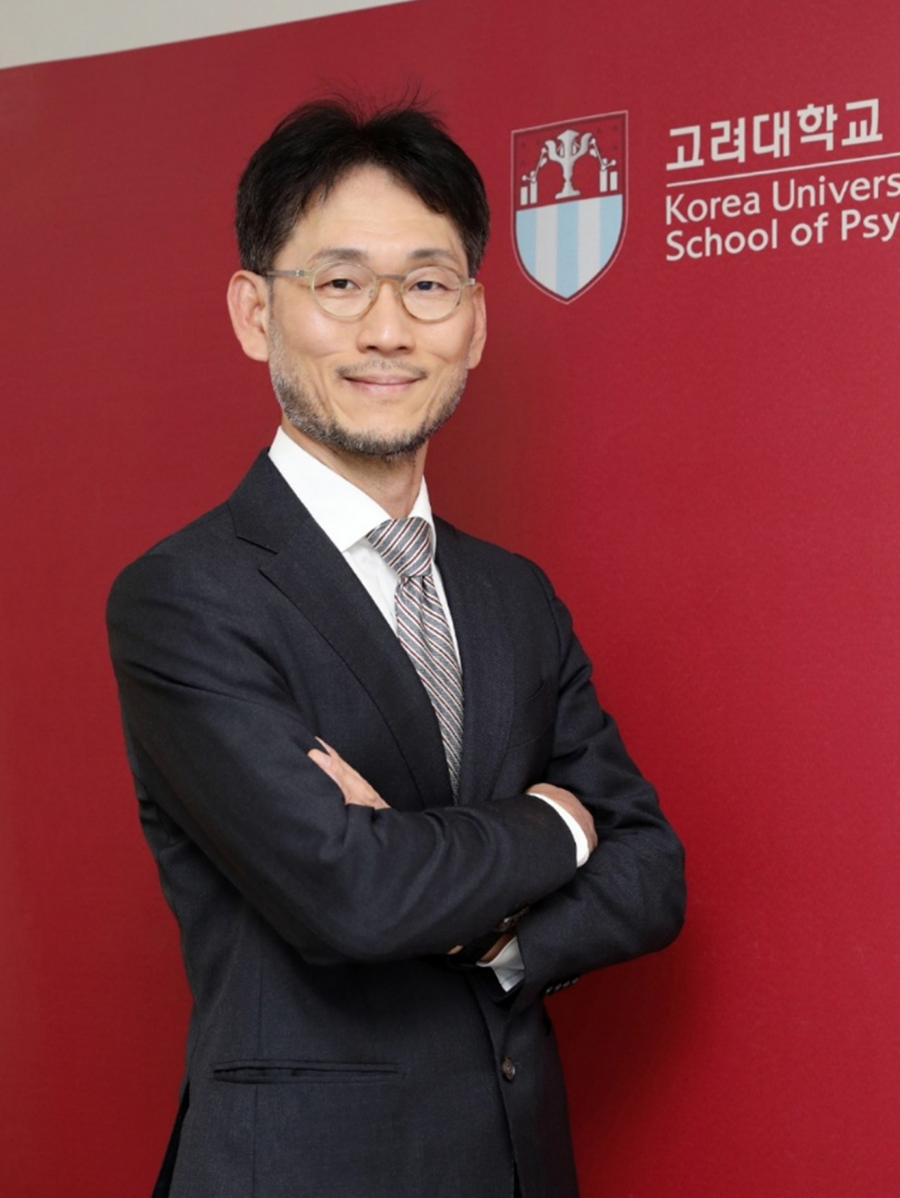
“To be completely honest, I am a basic research
psychologist who has spent most of his time in the
laboratory since joining the Department of Psychology at
Korea University as an assistant professor in 2004.
Laboratory research involves persistently immersing
oneself in a problem in one’s own way, often in the hope
of making an unexpected discovery. It is therefore quite
different from administration or leadership, which
requires gathering and coordinating a wide range of
opinions.
Although I am a psychologist, the areas I have primarily
studied—such as learning theory and brain-signal
analysis—are also somewhat removed from solving
immediate real-world problems. In that sense, I believe
I am beginning this role as Dean with a great deal to
learn from the outset. How should I put it? It feels as
though I was born a wandering hyena but have suddenly
become a beaver expected to build a dam diligently every
day. For that reason, assuming this position at such an
important moment for our School has honestly felt like a
considerable responsibility.
From my very first day, approval documents began pouring
in. Reading them felt like trying to understand academic
papers from a completely unfamiliar discipline, written
in a language I barely knew. Nevertheless, there was one
thing I firmly believed: our School of Psychology is an
exceptionally cohesive and united organization. All 18
faculty members readily step forward and cooperate
whenever the School needs something. When forming a
committee, therefore, there is no need to worry about
whom I can ask for help. Trusting these dependable
colleagues, I decided to take on this role.”
“As an undergraduate, I majored in biology. In 1989, I
entered the graduate program at Korea University and
received my master’s degree in physiological psychology
under the supervision of Professor Ki-Seok Kim. I
subsequently studied abroad, earned a doctoral degree in
behavioral neuroscience, and continued my research
career. Perhaps because of this background, I am still
occasionally asked whether I am a psychologist or a
neuroscientist. Similarly, many psychologists are asked
whether psychology belongs to the sciences or the
humanities.
Although psychology was introduced to Korea more than a
century ago, such questions reflect the fact that
psychology is still not sufficiently understood as a
discipline that scientifically investigates the human
mind and behavior. From that perspective, the decision
in 2021 to establish Korea’s first independent School of
Psychology—and to allow its graduates to choose between
Bachelor of Arts and Bachelor of Science
tracks—represented a highly symbolic transformation.
Personally, I have also moved between the sciences and
the humanities while pursuing an academic identity that
is not confined by methodological or institutional
boundaries. In the process, I have collaborated not only
with psychologists but also with researchers in
philosophy, medicine, engineering, and various other
disciplines. I hope that this experience in
interdisciplinary communication and collaboration will
be of at least some help in leading the School.
It also happens that I have taken on this role at
precisely the moment when the School of Psychology,
following its establishment, must begin to fully realize
its identity as a convergence discipline. In that
respect, I feel a kind of resonance that is difficult to
explain scientifically.”
(Laughs.)
“Without question, the greatest strength of our School
is its outstanding people. We are a relatively small
School with 18 faculty members, but every one of them
conducts research at the highest level, both nationally
and internationally, in their respective fields. That
may sound somewhat conventional, so let me put it
another way: it is like having to select a starting
lineup but being unable to find a single player who
deserves to be left off the roster.
On the strength of this research capacity, our School
currently operates the only large-scale BK psychology
program in Korea. Through this program, approximately 80
master’s and doctoral students receive stable research
scholarships each year. The quality of our undergraduate
students also continues to improve, and I am
particularly impressed that we are attracting students
with a strong affection for and commitment to
psychology.
In addition, the Graduate School of Psychology
Convergence Sciences was established three years ago to
further expand the School’s system for cultivating
talent, and it produced its first graduating class this
year. It is an evening professional graduate school—the
first of its kind in Korea—created to enable people from
a variety of professions and areas of expertise to grow
by finding points of connection with psychological
science. Each year, it attracts excellent applicants and
maintains a highly competitive admission rate of more
than three applicants per available place.
Supported by this strong pool of talent, the areas in
which psychology graduates can contribute are also
expanding rapidly. In the past, psychology was primarily
recognized in clinical and counseling settings or in
corporate human-resources departments. Today, however,
the expertise of psychology graduates is valued in a
much wider range of fields, including advanced
industries such as automobiles and gaming, as well as
data science, human factors, drug development, and
artificial intelligence. I expect this trend to
accelerate further.”
“Relatively speaking, our School still has
considerable room for improvement in terms of its
physical infrastructure. Above all, we have not
secured sufficient space appropriate to the status and
responsibilities of the School. Faculty offices are
currently dispersed across several locations on
campus, making it difficult to integrate research and
administration at the School level. Space for student
activities and research is also insufficient.
To address these issues, the entire School community,
led by the Development Planning Committee, has been
engaged in continuing discussions. In consultation
with the University administration, we hope to develop
a master plan in the near future that connects these
needs to the School’s long-term growth.
Another important task is expanding the faculty.
Naturally, more faculty members would always be
welcome, but I believe an independent School requires
a certain critical mass—at least 20 full-time faculty
members—to operate in a stable manner. At present,
every professor effectively performs two roles,
undertaking administrative responsibilities in
addition to research and teaching.
Our administrative staff members also compensate for
the limitations of our infrastructure with remarkable
professionalism and dedication. Nevertheless, as the
School continues to expand in scale and
responsibility, establishing a more efficient
administrative system and stronger institutional
support will be an important priority.”
“Psychology has always carried the label of being ‘new.’
If we trace the origin of modern psychology to Wilhelm
Wundt’s establishment of an experimental laboratory, it
is indeed a relatively young discipline, only about 150
years old. More importantly, however, psychology
investigates the human mind, which has always been
regarded as an unknown frontier. It has also been deeply
connected to the birth and development of cutting-edge
fields such as cognitive science, neuroscience, and
artificial intelligence. In that sense, the word ‘new’
may be one of the best descriptions of the essential
character of psychology.
I believe the time has now come for psychology to build
on these characteristics and assume the role of a mature
convergence discipline—one that integrates and
systematizes the diverse fields of knowledge and
technology around it. Psychology has already accumulated
ample capacity to perform this role. The theories and
methods through which psychology has systematically and
scientifically investigated the human mind—once
considered solely a subject of philosophical
reflection—can now be applied proactively to solving the
social and technological problems we face today.
As these changes continue, the range of activities
available to psychologists will also expand.
Psychologists will remain important in traditional
mental-health fields, but their role will become
increasingly significant in emerging areas that combine
psychology with digital technology, including digital
addiction and human–technology interaction.
Artificial intelligence, in particular, is developing so
rapidly that even experts find it difficult to predict
its future. Yet it is precisely under these
circumstances that psychology has much to contribute.
Psychology is the discipline that has studied the nature
of intelligence longer and more systematically than any
other. Psychological knowledge is also essential for
understanding and interpreting abnormal behaviors in
artificial intelligence, such as hallucination and
sycophancy.
Notably, several faculty members in our School are
already actively pioneering advanced areas of research,
including big data, artificial intelligence, and digital
therapeutics. Our students are also responding
proactively to these developments and preparing
themselves for the future.”
“Everyone tends to believe that their own field is the
most interesting. A legal scholar may find the law most
interesting; an architect, buildings; and a
cardiothoracic surgeon, the heart. But when we stop to
think about it, none of these things could be considered
‘interesting’ without a mind capable of experiencing
interest. How, then, does that mind work?
I believe that all of us who study psychology have asked
ourselves this question at least once. I hope we never
forget that it is our pursuit of this ‘ultimate
curiosity’ that binds us together as a community. This
is not merely a piece of humanistic rhetoric. It is also
a reminder of how close we have come to answering this
question compared with the many great thinkers who asked
it over the past several centuries but lacked the means
to investigate it scientifically.
It is at this point that the vast theoretical and
technological resources accumulated by psychology—from
operational definitions and statistical concepts to
sophisticated experimental designs and the latest
neuroimaging techniques—finally acquire their full
meaning.
I believe that our identity as psychologists lies in our
ability to hold fast to fundamental questions about the
human mind and behavior while systematically applying
the resulting knowledge to the practical challenges of
the future.
The School of Psychology must become a community that
cultivates people with precisely these qualities. I
dream of a day when anyone who has had the pleasure of
working with one of our graduates will learn that they
studied psychology at Korea University and nod
knowingly, saying, “Ah, that explains it.”